
Hiring an AI developer? Ask for the test
Jerome Privott · · 3 min read
The question that sorts AI developers is "how will we both know it works?" If the answer is a demo, you are buying a demo.
A demo shows the happy path once, on an input someone picked. Your workflow will run every week on inputs nobody picked. What you want to buy is a written definition of correct and the thing that checks it.
These are the questions I'd ask any AI developer, us included.
1. What does correct mean, in writing, before any code?
Ask for three to five pass/fail statements about the output, specific enough that two people would grade the same result the same way. "Every invoice total matches the PO within $0.01" is one. "Accurately processes invoices" is not.
If they can't write the statements before building, they can't test against them after.
2. What checks those statements, and when does it run?
Someone eyeballing outputs during the build is not a check. Ask what runs the criteria, what it returns, and whether it runs again after every change, including after the developer is gone.
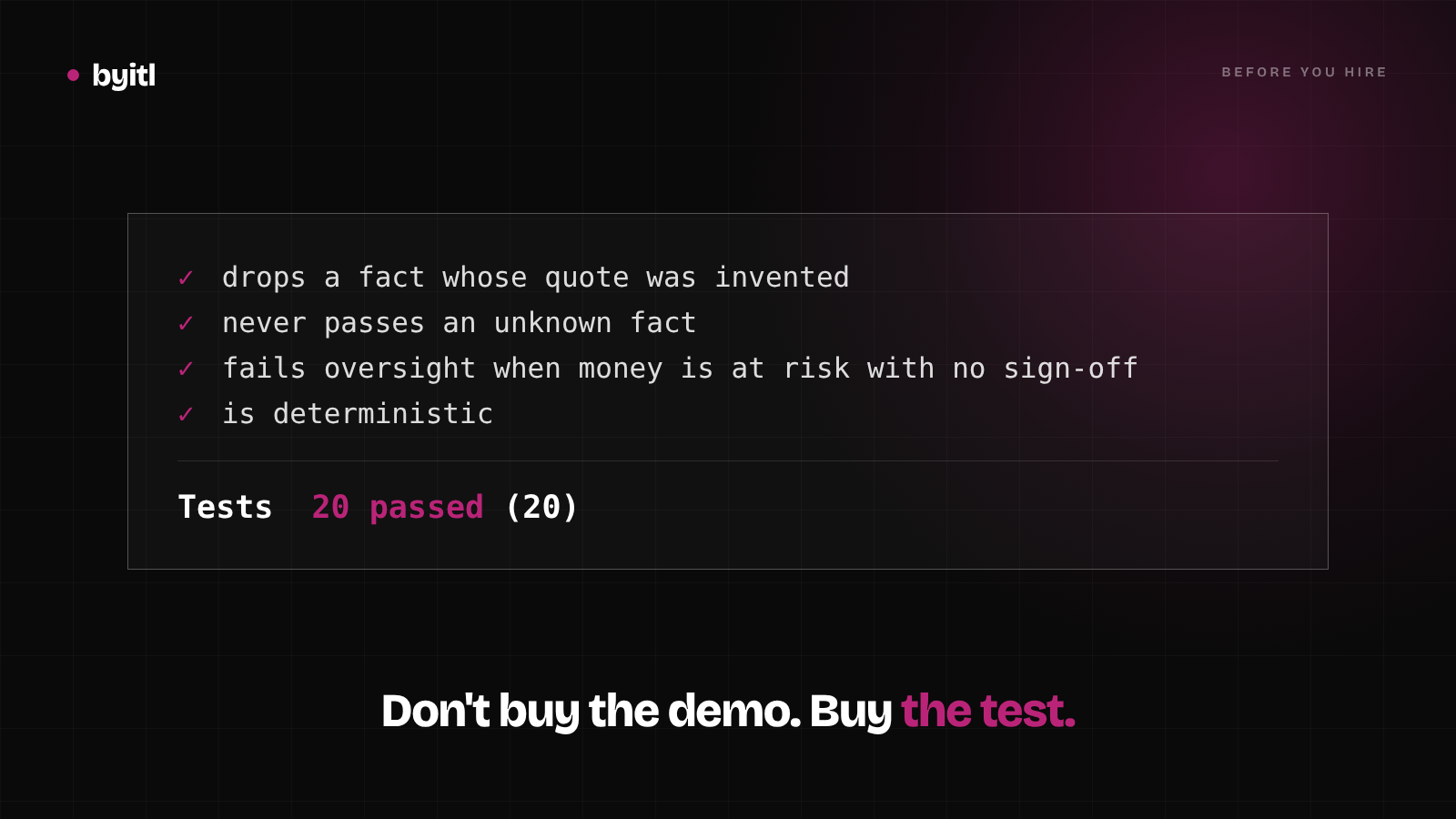
Ours are code, and the checker has its own tests. These are real test names from the review engine behind the free Workflow Test on /ai:
✓ drops a fact whose quote was invented, and lists it
✓ never passes an unknown fact, and leaves it out of the score
✓ fails oversight when money is at risk with no sign-off, and says how to fix it
✓ calls judgment-driven work not a fit for full automation
✓ is deterministic

Tests  20 passed (20)
The last one matters more than it looks. A check that can give two answers for the same input is an opinion.
3. Where does the model sit, and what checks its output?
Ask them to draw the workflow and circle every step where a model makes a decision. Each circle needs an answer to "what catches it when it's wrong?"
Most steps in a business workflow shouldn't be a model at all. I worked through where the model belongs, with a real run, in AI agent vs Zapier or n8n.
4. Who approves before it reaches a customer or money?
If the workflow sends anything to a customer or moves money, ask where the human sign-off is. A careful developer adds one even when you didn't ask for it.
5. Who owns the code and the test?
The code should live in your repository, under your account, and that includes the checker. If the test only runs inside the developer's platform, you lose it the day you stop paying them.
6. What does it cost to run each month?
The build price is one number. Ask for the cost per run as well: model tokens, platform fees, and the minutes a person spends approving. Then ask what stops a bad day from becoming a bad bill. Our intake workflow holds anything past 50 analyses in a day instead of running them.
For build prices, what freelancers and agencies actually invoiced in 2026 is on our cost page.
7. What happens if it fails the criteria at handoff?
Ask how payment ties to the criteria. Ours: half up front, and the second half is owed only if the agreed criteria pass. You keep the work either way. Whatever the terms, the point is that the definition of done is the same document the payment refers to.
8. Can I talk to a past client?
Ask. For our AI offer the honest answer is not yet, and we say that on the page rather than invent one. What we can show is the multi-agent systems we built for our own work, each with a gate that can fail it, and what those gates caught.
If anyone you're talking to is thin on references, ask to see the test for something they built for themselves. Someone who checks their own work will have one.
Want those eight answers in writing before you pay anything? That's how a verified workflow starts.
Related
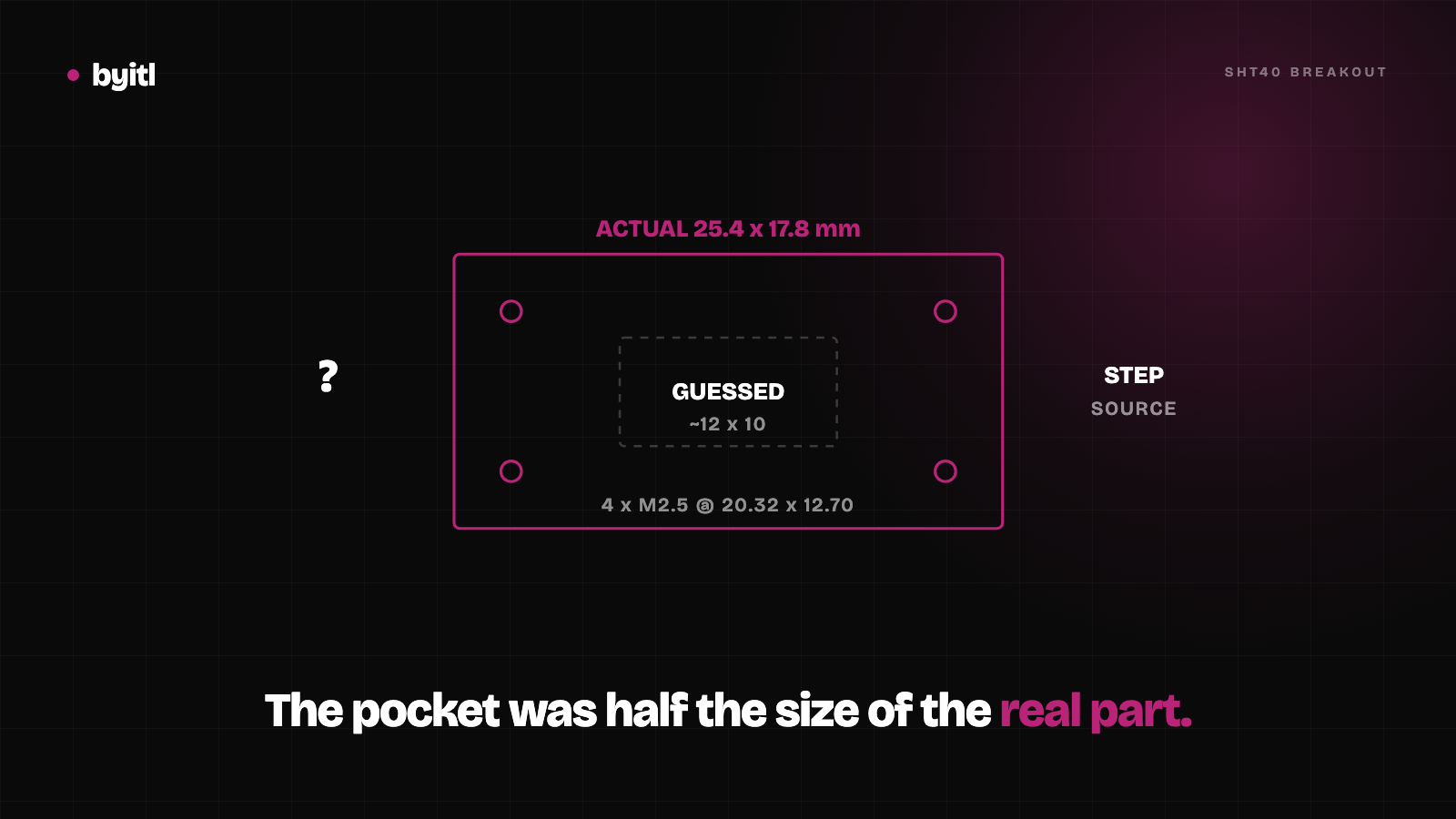
The agent guessed a sensor's size. We built a mount around a part that doesn't exist.
You cannot prompt a model out of guessing. You can make the guess fail a gate: require a provenance field and reject any number without one.
· 4 min read
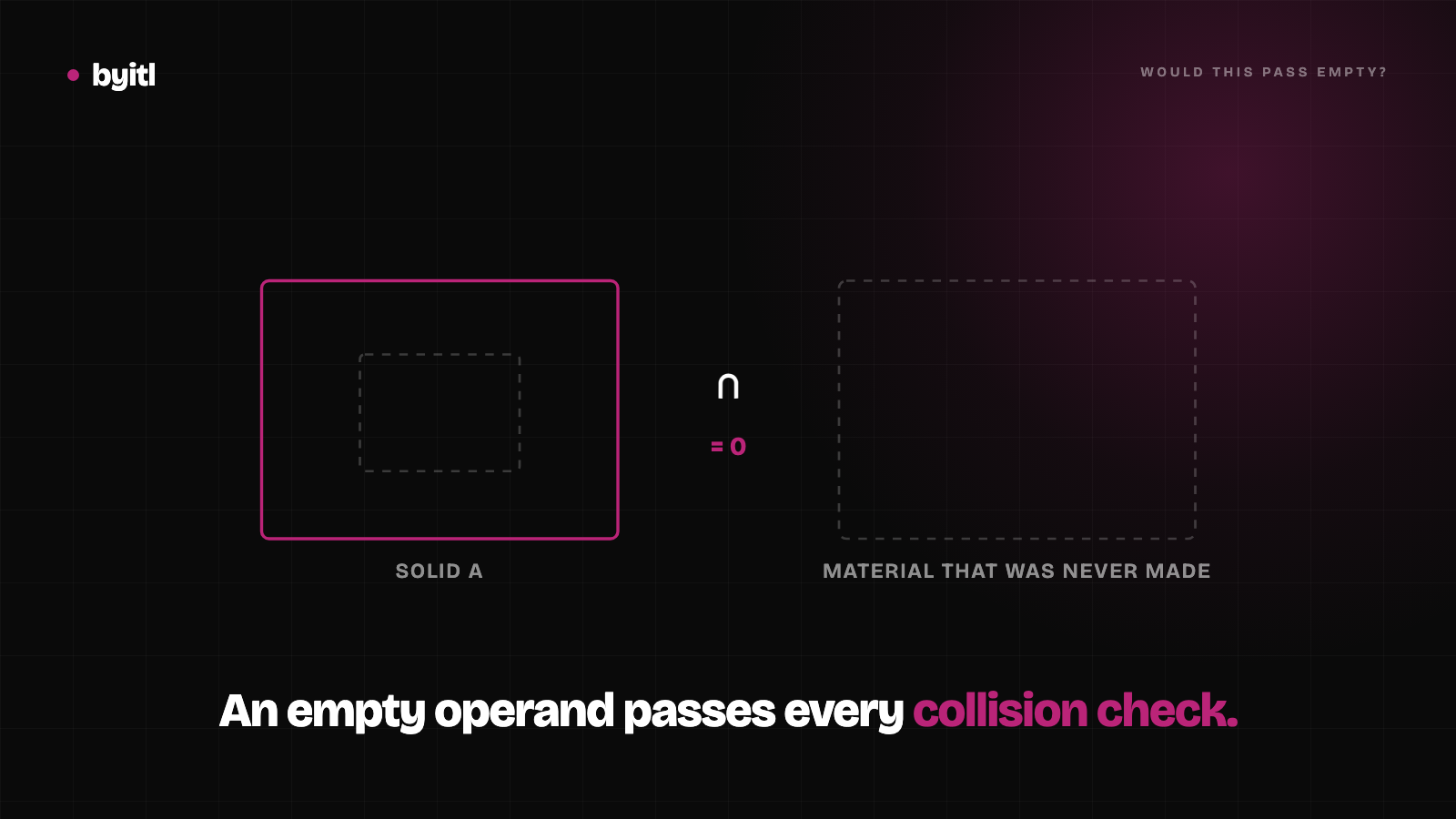
Our QA agent reported zero interference. The part had a hole in it.
An interference check measures overlap between solids. It cannot see material that was never there — so it passes a part with a wall missing.
· 4 min read
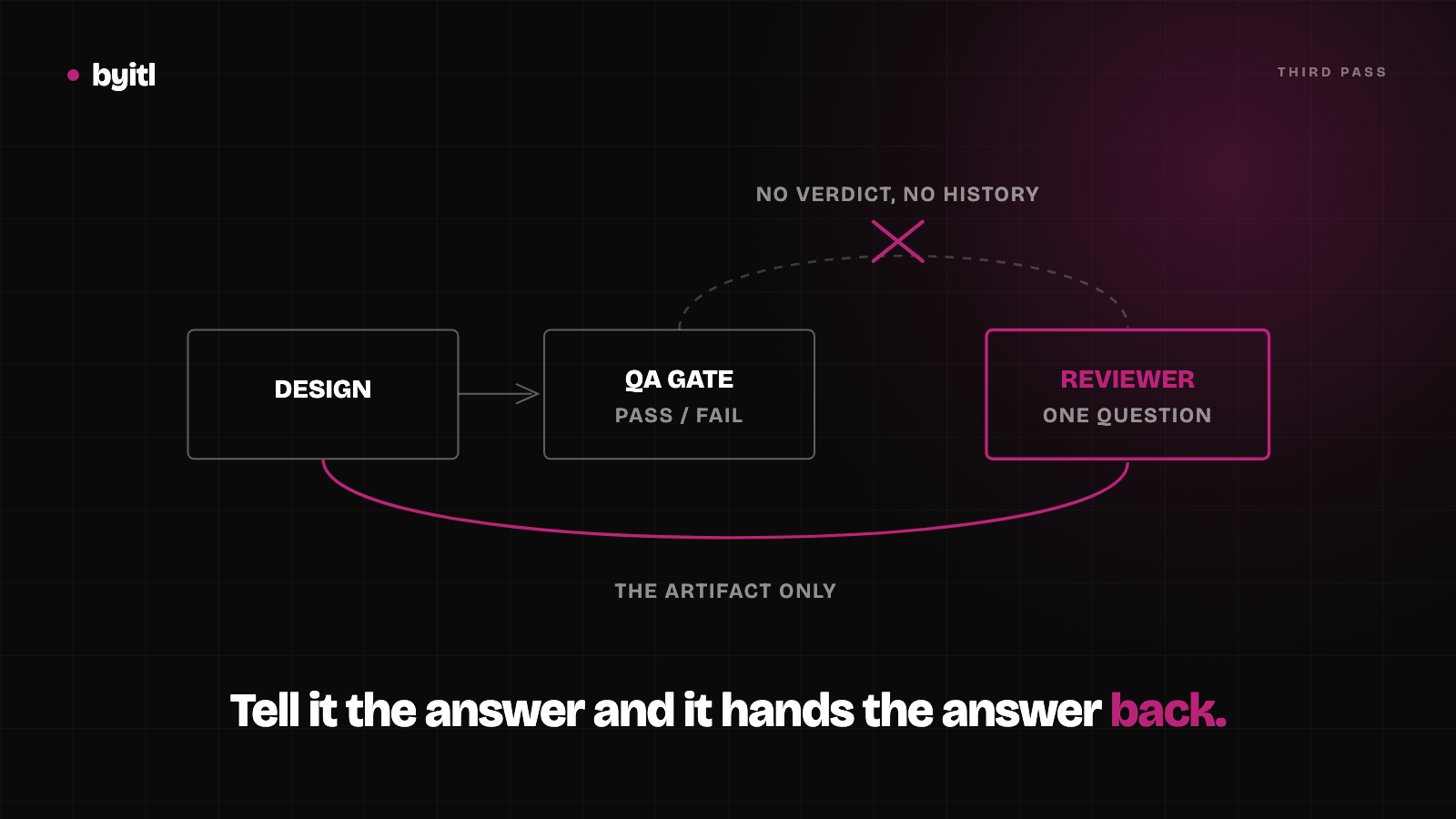
The third reviewer has to be blind
Hand an agent your hypothesis and it hands the hypothesis back, confirmed. The only review worth running is one that never saw the first two.
· 4 min read