
Is my prototype ready to sell? What comes next
Jerome Privott · · 6 min read
The short answer
No. A working prototype proves your idea works. It is not yet a product you can sell. It is usually bigger than the final thing, it has no retail finish, only one unit exists, and nobody has certified it or tooled it for volume.
What comes next is a short list, in this order: write down what the prototype got wrong, fix it in a revision, build a small batch and put it in real hands, get it certified at a test lab, and only then pay for production tooling. You own the files from the prototype, so you can take each of those steps with whoever fits.
What does a working prototype prove?
It proves the device does what it is meant to do. Ours are functional prototypes, not high-fidelity ones: the board, the firmware (the code that runs on the chip) and the case work together, and you can test it, demo it and hand the files to a manufacturer.
That is a big step. It is the step that turns "I think this could work" into "here, press the button." It is the thing you show investors, testers and manufacturers.
What doesn't it prove yet?
Five things, and each one is a step after the prototype.
| What a prototype is | What a product needs |
|---|---|
| One unit, assembled by hand | The next 100 have to come out the same |
| Printed or laser cut in one colour | A retail finish and packaging |
| Often larger than the final product | The size people will actually buy |
| Not certified | Certification from a test lab |
| Case files made for printing | A case redesigned for a mold, if volume calls for it |
The first row is the one people skip. One good unit shows the design can work. It doesn't show the next batch will. Our own humidor controller, the HC-01, is the proof: one batch of five boards (rev D) came back with all five defective: three dead on the USB-C power section and two with a display connector that wasn't fully soldered. The fixed design (rev E), built by a different board maker, came back five for five. You only learn that by building more than one.
Our own example: what HC-01's first prototype still couldn't do
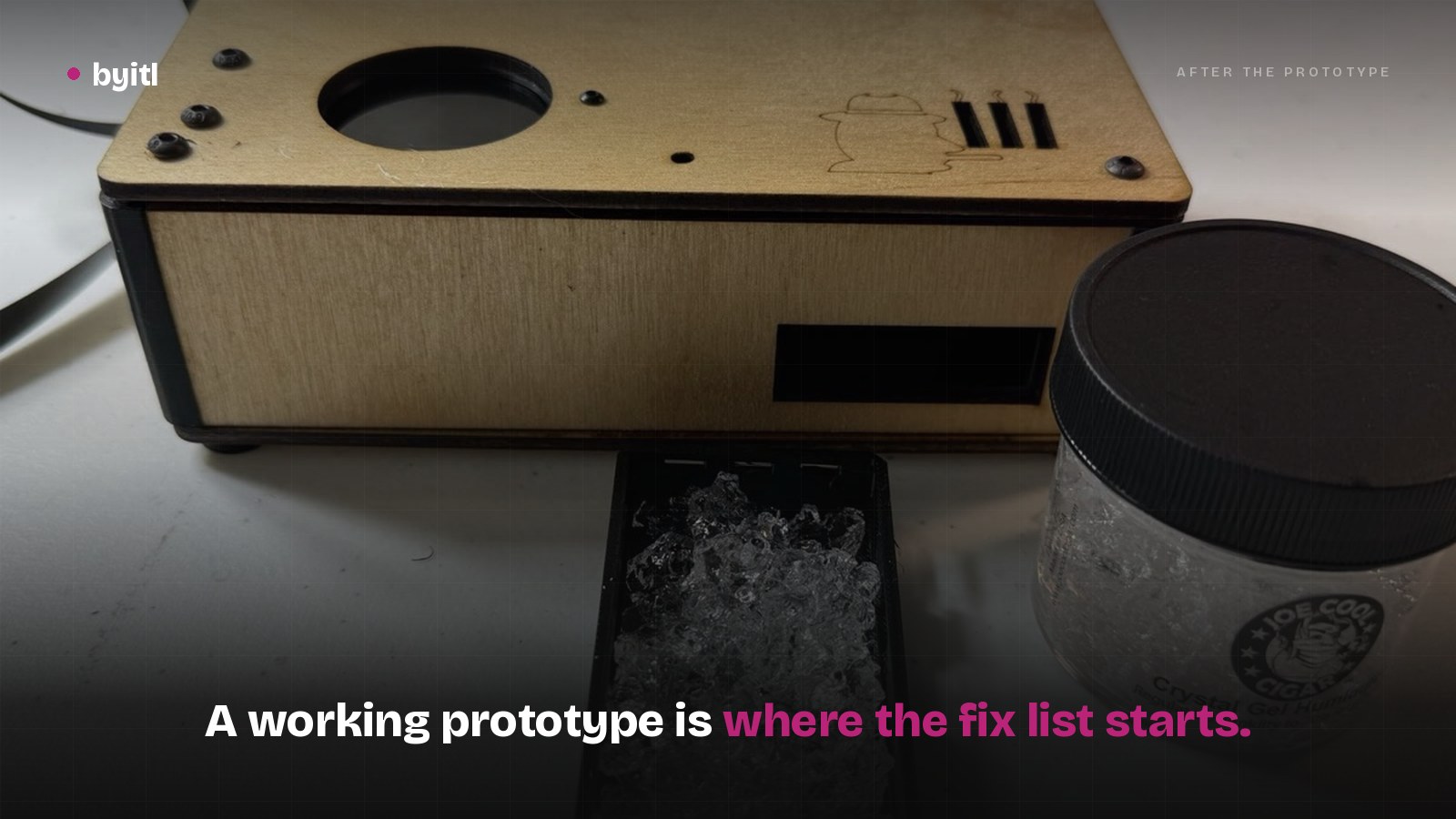
HC-01 works. It runs in a real humidor, reads the air and runs its fan on its own. When I wrote it up in October, I also listed what was wrong with it, because that list is the real output of a first prototype:
- Too big. 151 × 90 × 45 mm, roughly double what it should be.
- A glued part. The display holder was held in with superglue because it didn't seat flat.
- No phone setup. It got onto Wi-Fi from a command-line tool, which no customer will ever own.
- Half a control loop. It can add humidity. It can't take it away.
None of that showed up until the device existed. All of it is in It works. It is also too big.
That list became the job description for the next revision, rev F. The new case is 127.5 × 69.1 × 45.4 mm, down from 151 × 90 × 45, and the round display now mounts on the circuit board itself. Rev F went out for a board quote on November 10.
Ordering it taught one more thing a single prototype never would. The board maker wouldn't buy the display panels and ship them loose, so we buy those panels ourselves and the boards arrive with the connector fitted and no screen. That is a supply question, and supply questions only show up when you order more than one.
What comes after the prototype?
Here is the order I'd take it in.
- Use it and write down what's wrong. Put it in the hands of a few people who would actually buy it. Write every problem down, the way the HC-01 list above is written. Don't fix anything yet.
- Fix the list in a revision. Board, firmware and case change together, so a revision touches all three. Expect at least one. HC-01's board went from rev D to rev E, and rev F is now designed.
- Build a small batch. A handful of units tells you whether the design builds the same way twice, and whether every part can be bought. We quote more units, or a small batch, separately.
- Get it certified. FCC certification is done by a test lab, not by the person who designed the device. Talk to a lab before you set a launch date. We can prepare the prototype for testing.
- Decide on tooling. An injection mold makes cheap parts fast, but you pay for the mold first. When we had our own palm-sized enclosure quoted, a single-cavity prototype steel tool came to about $10,000. Once steel is cut, every design change costs real money, so don't buy a mold while the list from step 1 is still growing. When to switch to injection molding has the break-even math.
- Hand the files to a manufacturer. You need the board fab files (Gerbers, parts list and pick-and-place), the firmware source and the case CAD. If you paid for the prototype, you should own them. Who owns my prototype design covers what to check.
Can I skip straight to production?
You can, but you'd be betting a mold and a production order on a design that has been built once. Most of what goes wrong in a first unit is cheap to fix in a revision and expensive to fix in steel. The HC-01 list above would have been a very expensive list to find after tooling.
How do I know I'm ready for the next step?
You're ready to move on from the prototype when:
- People who aren't you have used it, and you've written down what they hit.
- The fix list has stopped growing, or what's left on it is cosmetic.
- You know roughly how many you'll sell in the first year, not how many you hope to.
- You have the design files in your own hands.
If two of those are missing, the next step is another revision, not production.
Questions people ask
Is a prototype the same as a finished product? No. A functional prototype works but isn't retail-finished, certified or built for volume. It may also be larger than the final product.
Can I show my prototype to investors? Yes. That is one of the main things a working prototype is for, along with putting it in front of testers and manufacturers.
Can byitl manufacture my product? No. We build the first working unit and hand you every file a factory needs. More units or a small batch are quoted separately, and redesigning the case for injection molding is a separate engagement.
How many revisions will I need? Plan for at least one. Our HC-01 board went from rev D to rev E, and rev F is now designed. Each change came from a written list of what the last one got wrong.
When should I pay for an injection mold? When printing is what's slowing you down and the design has stopped changing. For our palm-sized enclosure, a prototype steel tool was quoted at about $10,000.
Have a device idea and want a working first unit, plus every file to take it further? See how a full prototype works. From $7,500, 4 to 6 weeks.
Related
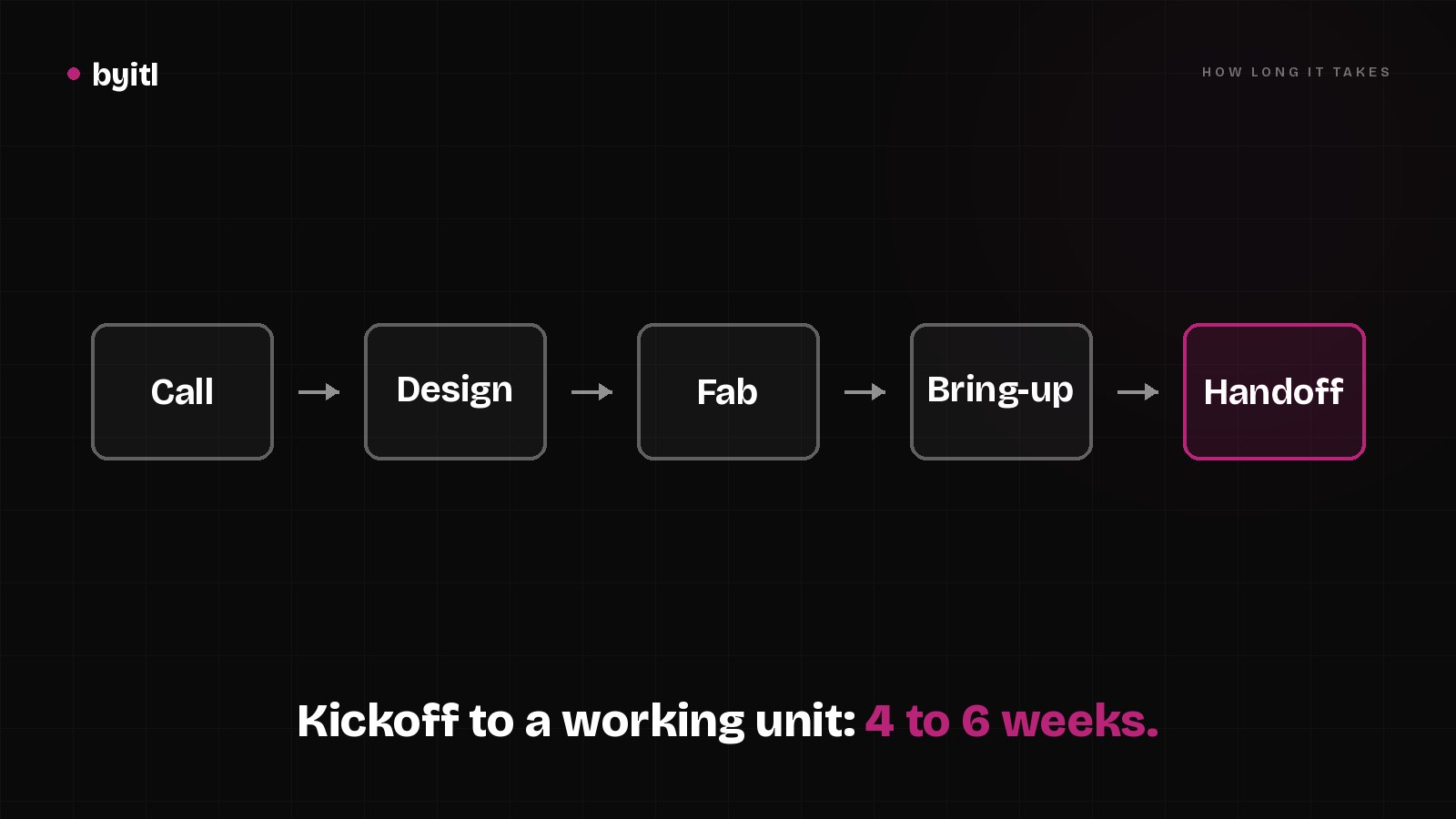
How long does it take to prototype an electronic product?
A working prototype of a new electronic device takes us 4 to 6 weeks from kickoff. About a week or two of that is the fab. Here's where the rest goes.
· 7 min read
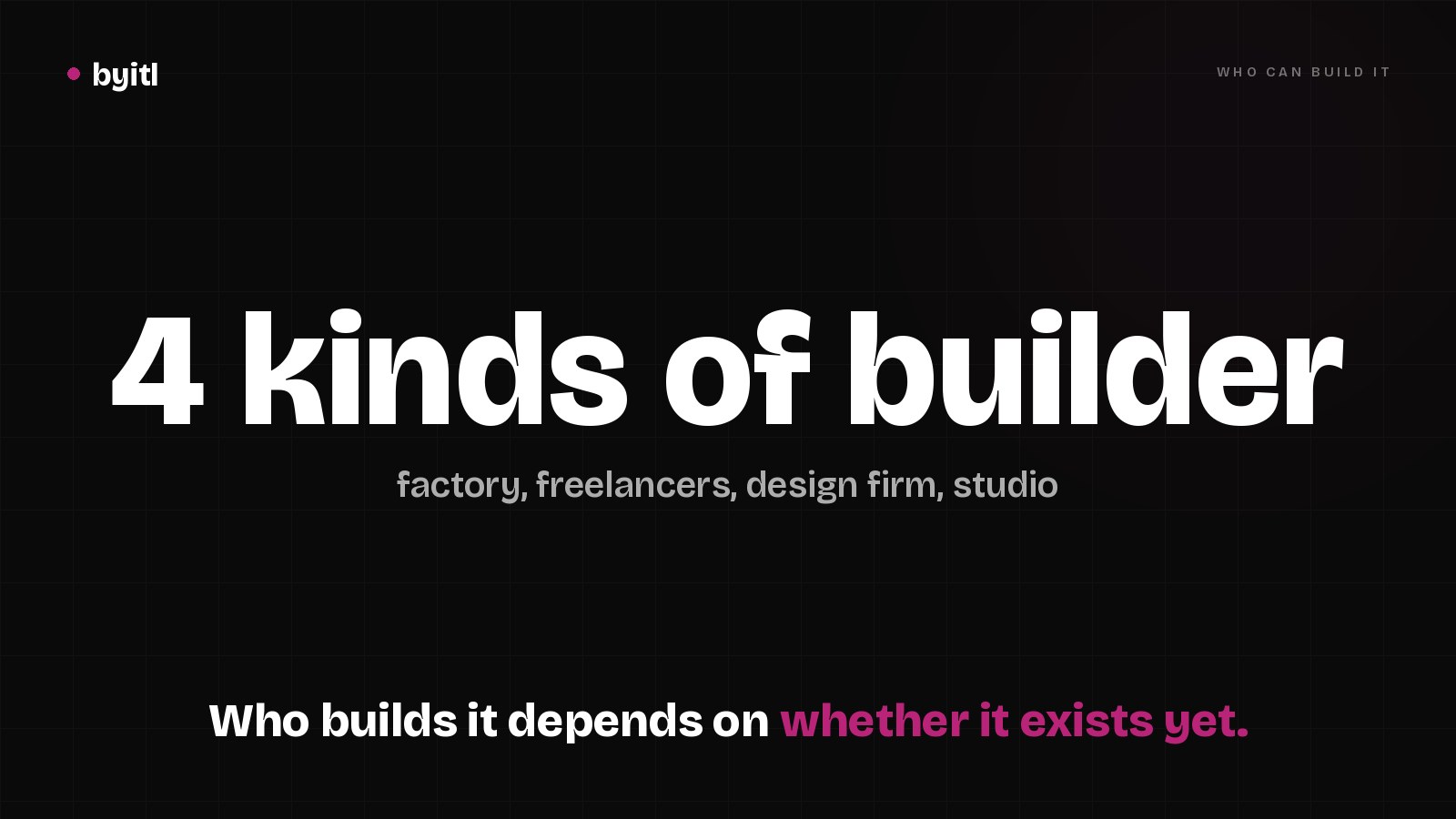
Who can build my electronic gadget idea?
A factory fits if your product already exists. A new device needs someone to design the board, firmware and case and build one. Here's who fits what.
· 7 min read
Who owns my prototype design, and do I need an NDA?
You should own the board files, firmware source and case CAD once you pay. An NDA keeps your idea private; it doesn't make you the owner.
· 7 min read