
How long does it take to prototype an electronic product?
Jerome Privott · · 7 min read
The short answer
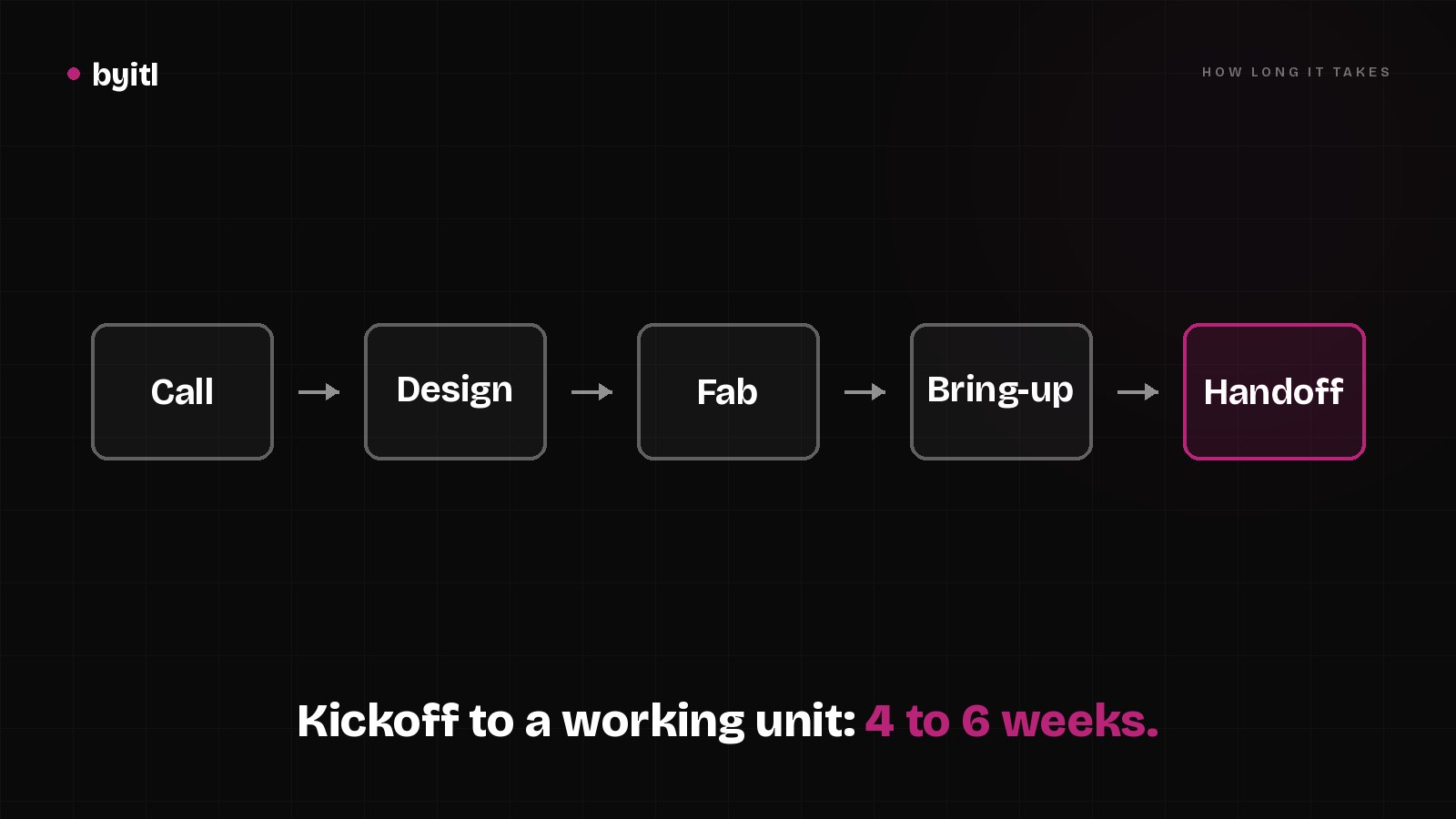
A working prototype of a new electronic device takes us 4 to 6 weeks, counted from kickoff to one tested unit. About a week or two of that is the factory building and assembling the circuit boards. The rest is design before the boards are ordered and testing after they come back. What stretches it is decisions that wait, and boards that come back wrong.
The clock starts at kickoff, not at the first call. Before kickoff there's a 15-minute call and a written quote with the scope, price and timeline, so you know the dates before you pay anything.
Where do the 4 to 6 weeks go?
They go to five steps, in this order.
| Step | What happens | What you do |
|---|---|---|
| 1. Scoping call | 15 minutes on what the device has to do. You get a written quote back: scope, price and timeline. | Describe the idea |
| 2. Design and approval | The circuit board design and renders of the case | Approve them. Nothing is ordered until you do |
| 3. Fab | A fab (the factory that makes circuit boards) builds and assembles the boards while the case is 3D printed or laser cut | Wait |
| 4. Bring-up | We load the firmware (the code that runs on the chip), test the board and fit it into the case | Wait |
| 5. Handoff | One working unit shipped to you, with every file needed to build more | Test it |
Only two of these have a set length. The call is 15 minutes, and it happens before the clock starts. Fab is about a week or two. Design and bring-up share the rest, and how they split depends on the device. A rechargeable battery, for example, adds a charger and protection circuit to design. One sensor on USB power doesn't.
Why is the fab time only an estimate?
Because it belongs to the fab, not to me. Our terms say fabrication and assembly lead times are our manufacturing partners' estimates, not commitments. I'd rather tell you that up front than promise a date I don't control.
Here's what it looked like on our own board. Our humidor controller, the HC-01, had its rev D board files dated July 7, 2026. The date is printed on the board itself. On July 12 the fab sent two questions about the files, after its review and before assembly. The five assembled boards arrived on July 16. That's nine days from the date on the files to boards on my bench, with a round of questions in the middle.
That question round is normal. A careful fab reads your files back to you before it builds. We answered in one email and told them to proceed. One of our answers turned out to be wrong, which is the next section's story. Answering a fab fast keeps the date. Answering it right keeps the boards.
What makes a prototype take longer?
These are the things that stretch a schedule.
- Waiting on design approval. Nothing gets ordered until you approve the board design and the case renders. That protects you from paying for hardware built from a design you didn't want. It also means the schedule waits on that approval.
- Changing what it does after approval. Adding a button or a sensor after the boards are ordered usually means changing the board. A changed board goes back through fab.
- A part the fab won't buy. On our current HC-01 revision, the fab told us it would not source the round display panel, so we order those ourselves from a distributor. A part like that adds its own shipping time.
- A very small device. Under about 40 mm, things get harder. A smaller battery and a tighter board take more design time.
- Boards that come back wrong. This is the big one, so it gets its own section.
What happens if the boards come back wrong?
You find out at bring-up, and the fix usually means another trip through the fab. That's the risk worth planning for. Here's a real one.
All five of our HC-01 rev D boards came back defective. Three never powered on. Two powered on, but the connector for the display was only partly soldered. We had designed small test pads into every power line, so a meter showed exactly where the power stopped. Proving the cause took two days.
There were two separate faults. The bad display joints were ours: a bug in our design tooling stripped part of the solder pad off those pins. That was the answer we'd waved through when the fab asked. The three dead boards were an assembly fault in a part of the board our files never touched. (The rev D story has the details.)
The fix was a new revision, rev E, sent through the fab again. All five rev E boards worked on the first attempt. Even then, bring-up found small problems that weren't the board. Two boards failed their first sensor test because of how the cable was wired. The display showed everything mirrored because one firmware setting was missing. None of these was hard to fix, but each took bench time. (The rev E write-up.)
What I take from that for your schedule:
- A first batch can come back wrong. A plan that assumes it won't is a plan that slips quietly.
- Testing is a step, not a hope. We flash and test the board when it comes back, before it goes into the case.
- Test pads are cheap insurance. They cost almost nothing at design time. They're why we could prove the cause in two days, instead of telling the fab "some of the boards don't work."
Can it be done faster?
Sometimes, by building less. Fab time is mostly out of anyone's hands. What you can shorten is everything around it.
- Cut version one down to the idea. Build the one feature that proves it. Extra modes can wait for version two.
- Approve quickly. The design step waits on your yes.
- Send exact part links. If you've already picked a part, a product link beats a description. We once printed a sensor pocket around a guessed size and had to reprint it.
- Tell me your date first. If you have a trade show or a pitch on a fixed day, say so before anything else. The quote states the timeline, so you'll know before you pay whether the date works.
If you need something to show next week, a development kit (a ready-made board you can buy off the shelf) wired to the parts skips fab completely. That's how HC-01 started: a dev board, a round display and a humidity sensor on jumper wires. It proved the idea worked. It didn't look like a product, and that's fine for a first test.
What do I need to do during those weeks?
Very little, but the little matters. Answer the questions on the scoping call. Approve the design when it's ready. Pay the three milestones: 40% at kickoff, 30% when you approve the design and 30% at handoff. Then test the unit when it arrives.
You can stop after any milestone and owe nothing further. Paid milestones aren't refunded, because the design time and hardware behind them are already spent.
Questions people ask
When does the 4 to 6 weeks start? At kickoff, the first milestone. The scoping call and the written quote come before it.
Is the timeline in the quote a promise? Every engagement starts with a written order that states the scope, price, milestones and target dates. Fab and assembly lead times belong to the fab, so those parts are estimates.
Can I get more than one unit in the same time? One working unit is included. More units, or a small batch, are quoted separately, and each one adds parts, assembly and testing.
Is the prototype ready to sell after six weeks? No. It's a working prototype that proves the device and gives a manufacturer every file it needs. Injection-mold tooling, volume manufacturing and FCC certification come after, and a test lab does the certification.
How long does a prototype take if I only have an idea? Starting from an idea is fine. Our published range is still 4 to 6 weeks from kickoff, and your quote sets the exact timeline. Here's what to write down first.
Have an idea and a date in mind? Send a brief or book a 15-minute call, and the quote will say how long yours takes. What it costs is here, and how the build works is on /prototype.
Related
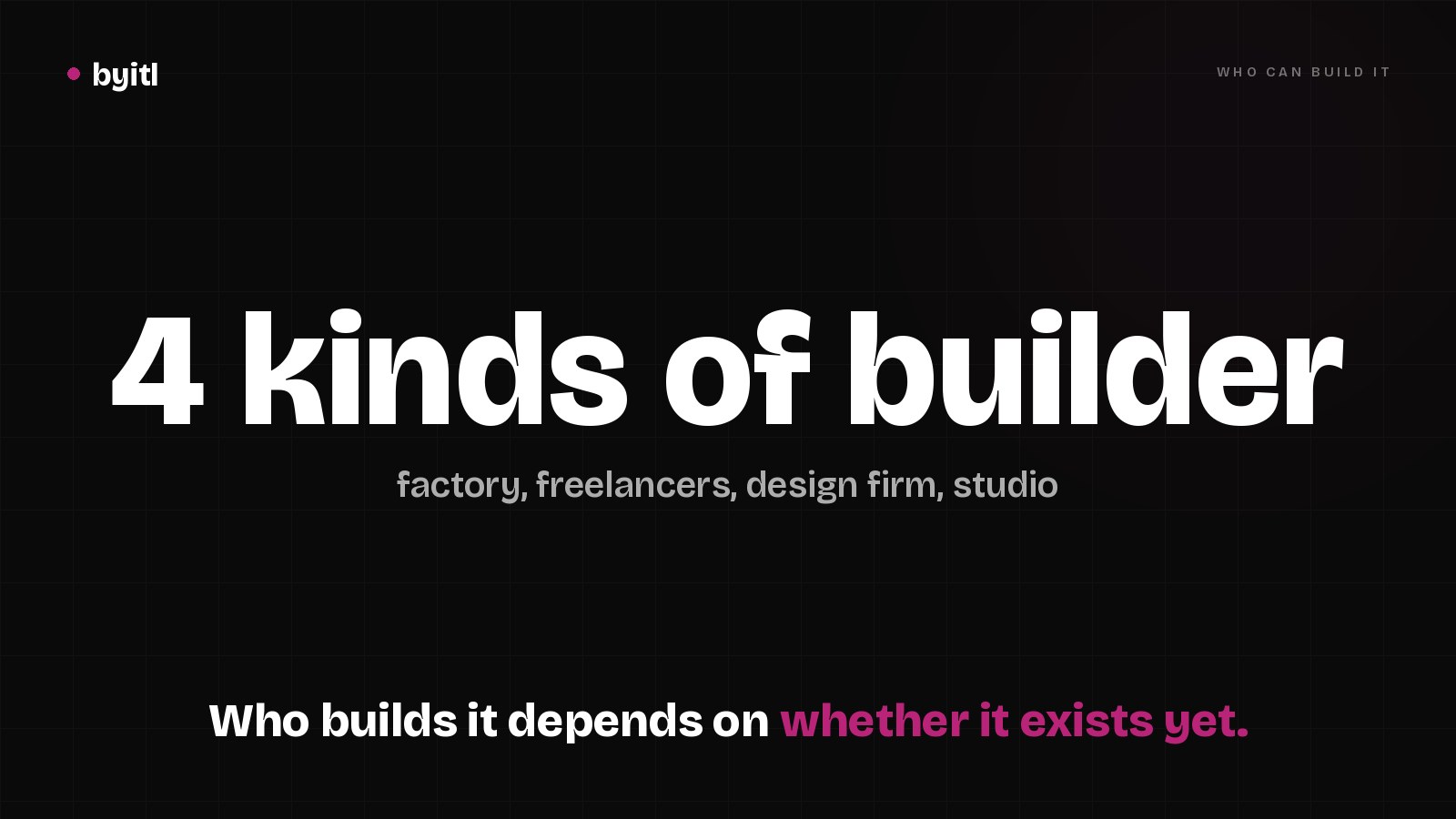
Who can build my electronic gadget idea?
A factory fits if your product already exists. A new device needs someone to design the board, firmware and case and build one. Here's who fits what.
· 7 min read
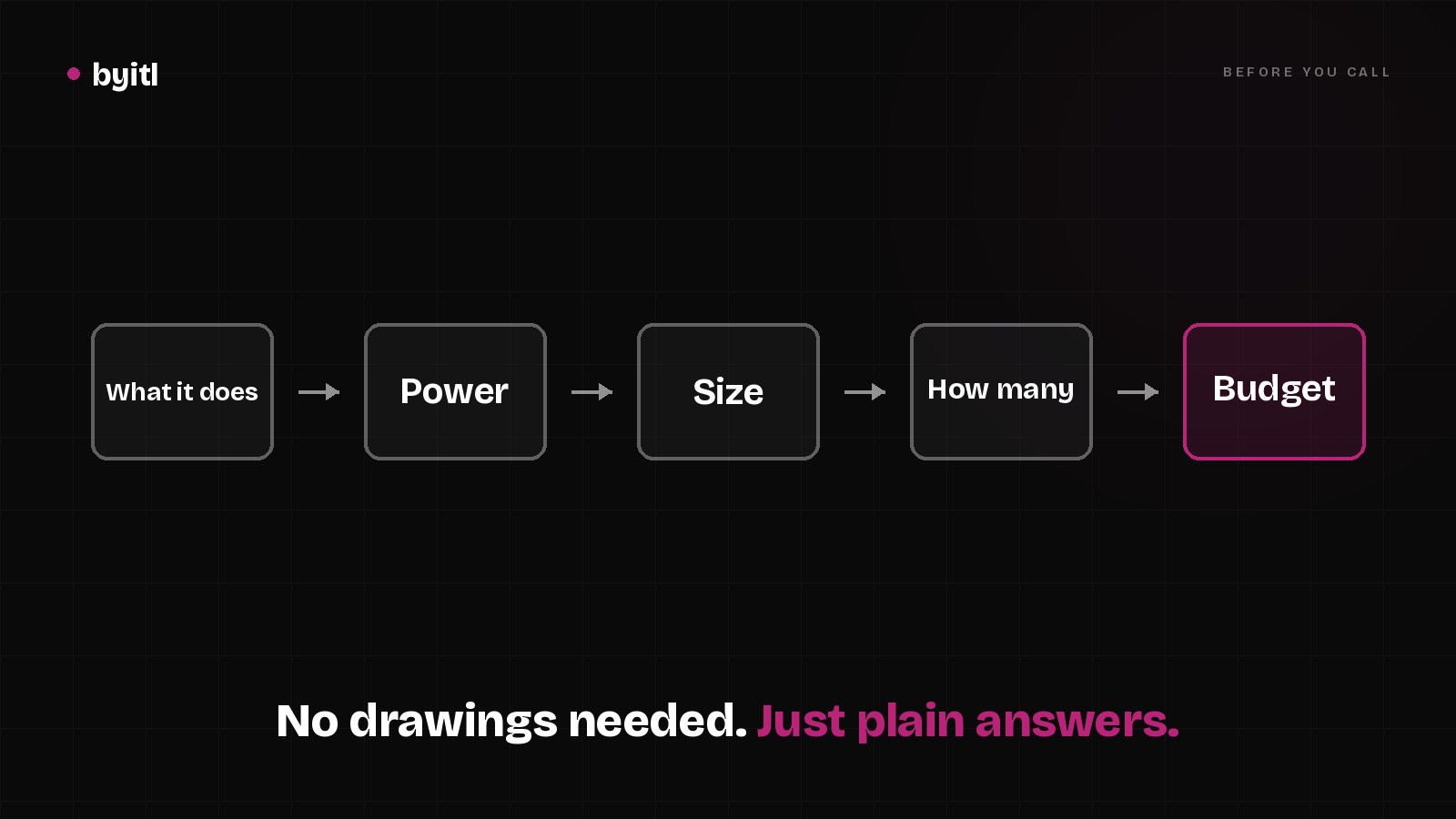
What to have ready before you talk to a prototype engineer
No CAD needed. Write down what it does, where it lives, its power, size, how many you need and your budget. A 15-minute call turns that into a quote.
· 7 min read
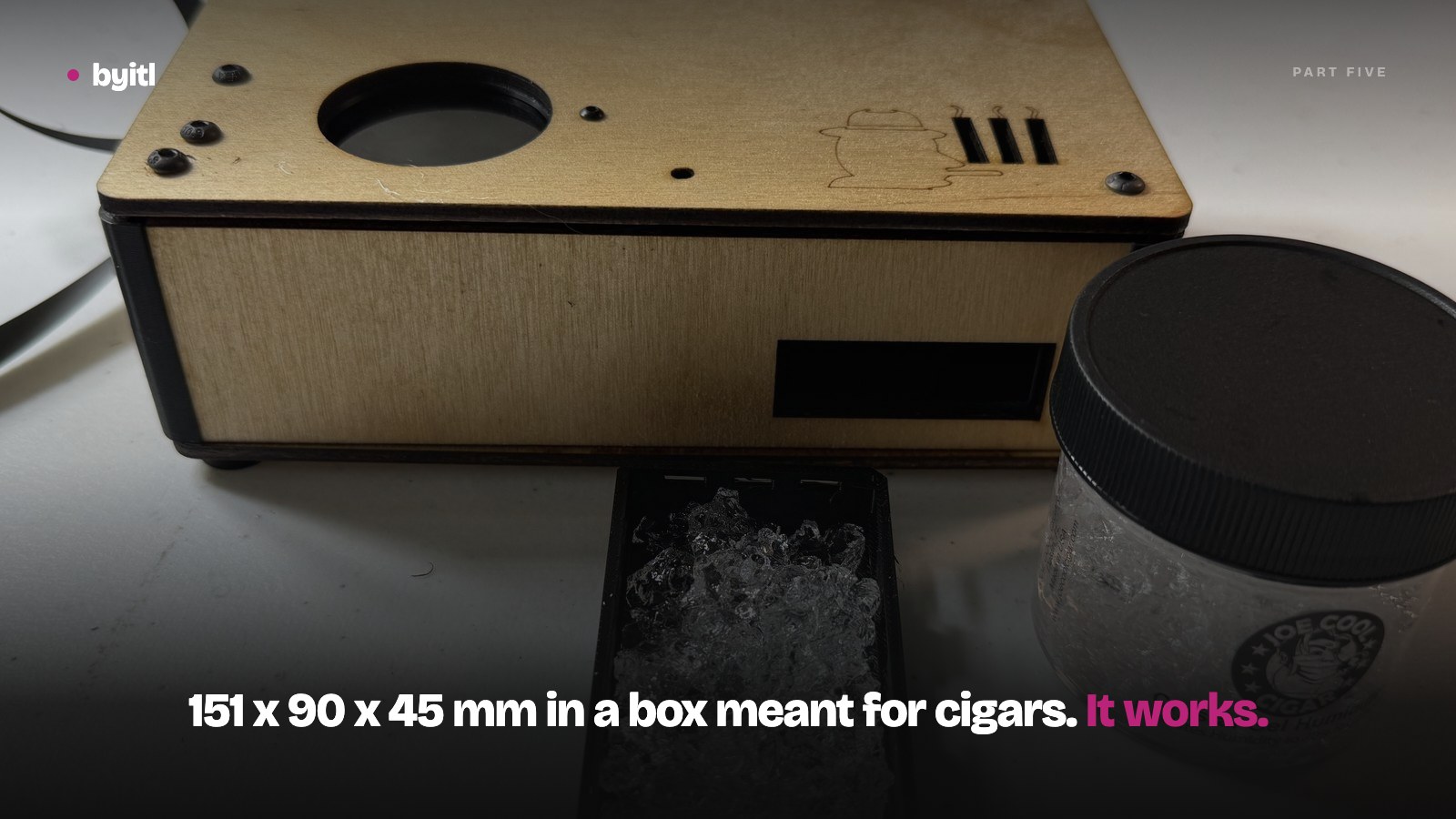
It works. It is also too big.
Part five. HC-01 is running in a real humidor: 522 logged samples, agreement with an independent hygrometer, and one closed control loop.
· 6 min read