
What to have ready before you talk to a prototype engineer
Jerome Privott · · 7 min read
The short answer
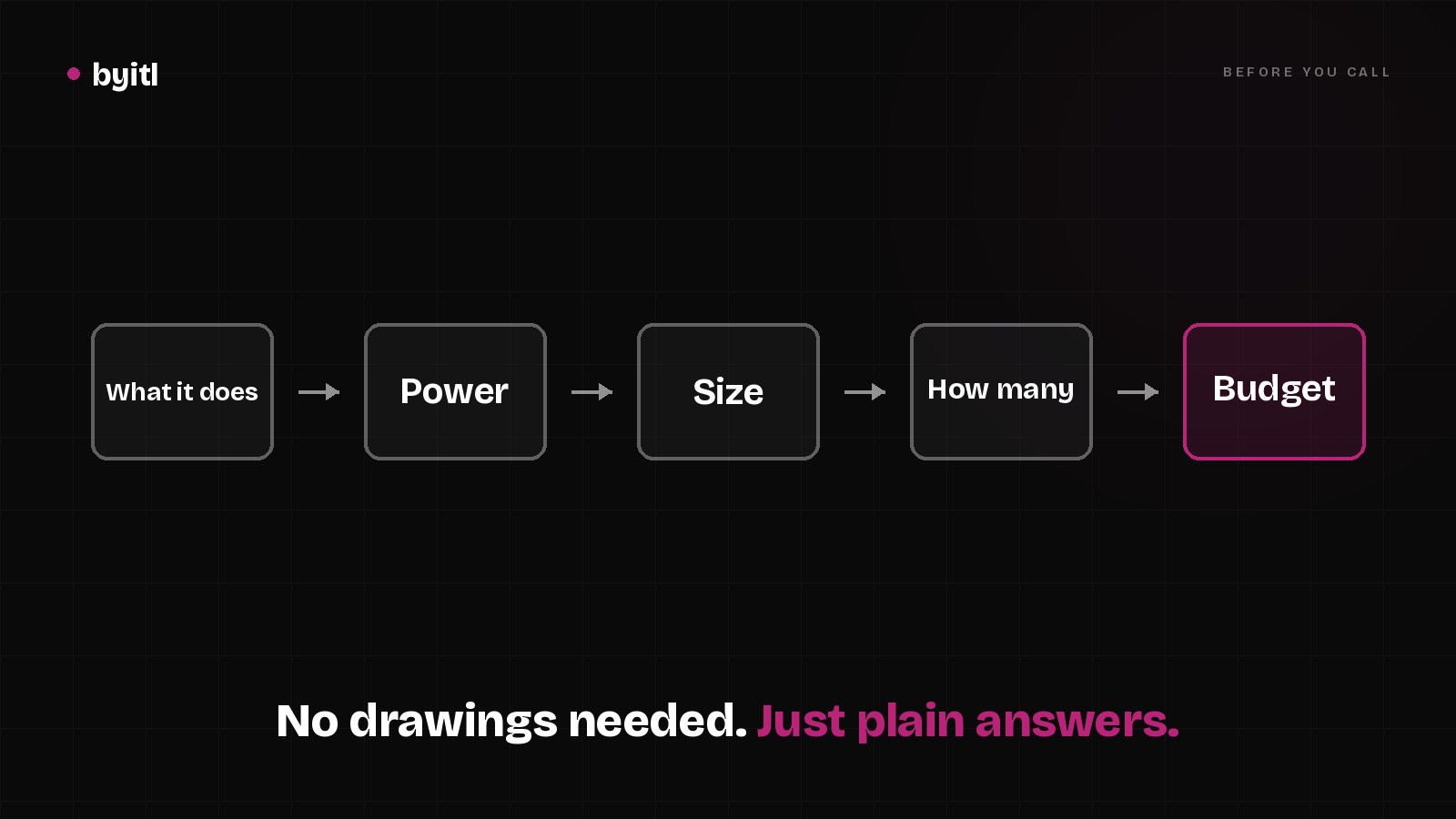
You don't need drawings, CAD files or a schematic before you talk to someone about building your device. You need a few plain answers written down: what it does, who uses it and where, how it gets power, roughly how big it is, how many you need, and what you can spend. With those, a 15-minute call is enough for us to send back a written quote with scope, price and timeline.
That's the whole list. The rest of this post explains each item and why it matters, and what to bring if you have more than an idea.
Do I need drawings or a working model first?
No. A clear description of what the device should do is enough to start. A sketch helps. So does a photo of something similar, a breadboard, a schematic or an existing board. None of them is required.
You can come with an idea and a reason, not a part list. Choosing the parts is the engineer's job.
What should I write down?
Write a short page that answers the questions below. Plain words are fine. These are the same eight questions we use to scope a build. They're on our prototype page as a one-tap score that runs in your browser, and nothing is sent until you choose to send it.
| Question | A good plain answer | Why it changes the quote |
|---|---|---|
| What does it sense or read? | "One button and a temperature sensor" | Each extra sensor adds a part to place, code to read it, and a check that it reads right. |
| What does it drive? | "A light and a small speaker" | Motors, pumps, heaters and other big loads need extra circuits and protection. |
| How does it connect? | "Bluetooth to my phone" or "nothing" | Wi-Fi and Bluetooth come with the chip we use. LoRa or cellular need another radio and setup. |
| How is it powered? | "Plugs into USB" or "rechargeable, a week per charge" | A rechargeable battery adds a charger and protection. Months on small batteries adds power-saving code and bench testing. |
| How many circuit boards? | "I don't know" is fine here | Every extra board is its own layout, connector and fit. |
| Where does it live? | "Indoors on a desk" or "on a keyring" | Splash-proof and very small devices both take more work. |
| What software beyond the device? | "Nothing" or "a phone app" | A phone app is a separate software build on top of the device. |
| What do you need at the end? | "One working unit" | Two to five units add parts, assembly and testing for each one. |
Then add three things the table doesn't cover:
- One sentence from the user's side. "When the soil is dry, it lights up." Not a feature list. This sentence is what everything else gets checked against.
- A size, with a reference. "About the size of a car key fob" beats "small". Hold up something you own and measure it.
- A budget and a date. A range is fine. If you have a trade show or a pitch on a fixed day, say so first.
What if I've already bought parts or built something?
Send it, and send exact links to the parts. This is where I've made mistakes myself.
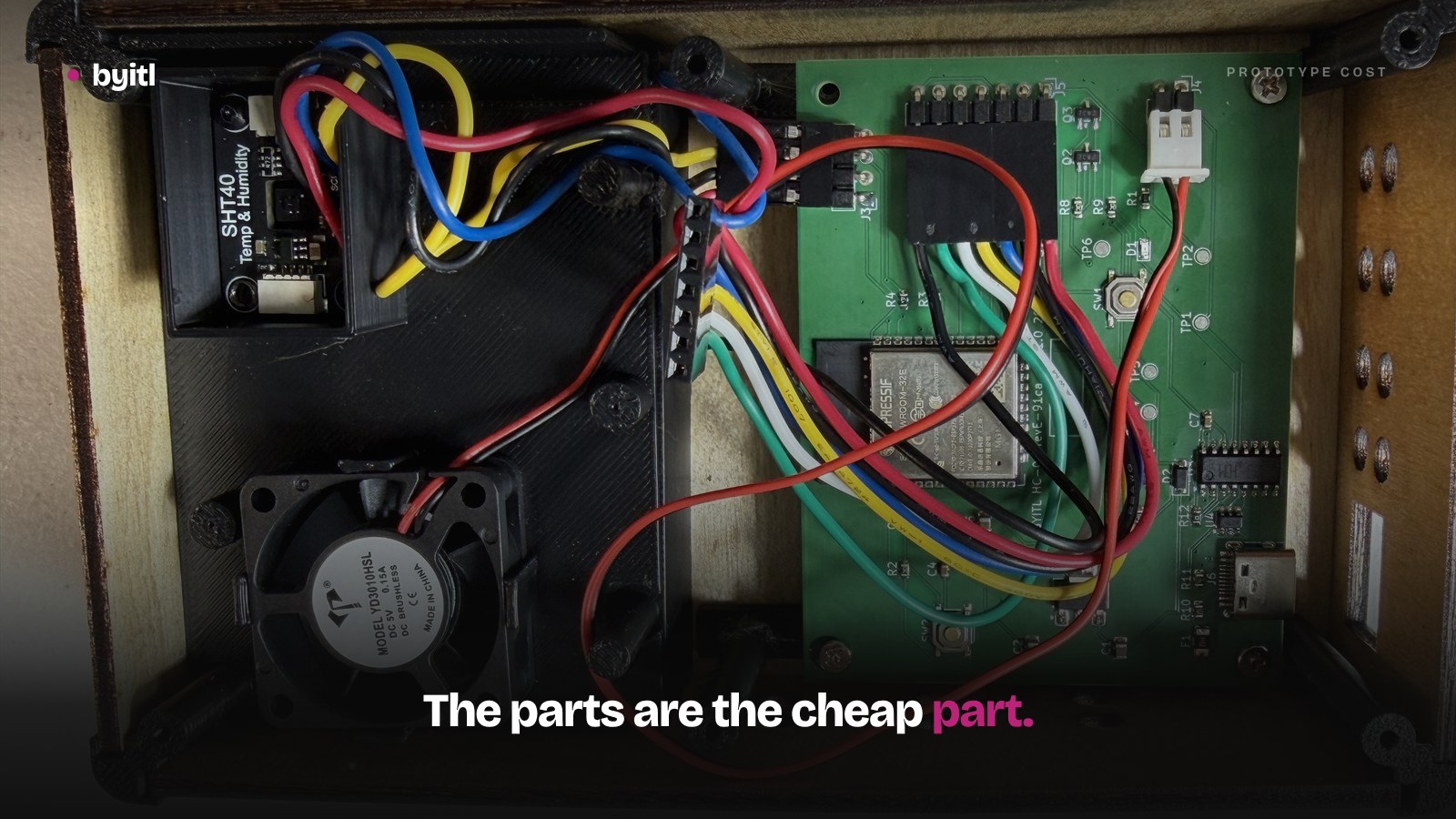
Our own humidor controller, the HC-01, started as an ESP32 development board, a round display and a humidity sensor wired together with jumper wires. That bench version proved the idea worked. Then our design agent drew a pocket for the sensor and guessed its size at about 12 by 10 mm. The sensor actually ships on a small carrier board of about 25 by 18 mm, with four mounting holes. The part didn't fit, and we reprinted. (The whole build is here.)
The lesson for you is simple. A product link or a photo of the actual part beside a ruler is worth more than a description of it. If you have a working breadboard, a short phone video of it running is worth more than either.
How exact does the size have to be?
Exact enough to say what "too big" means for you. Size drives a lot of the design.
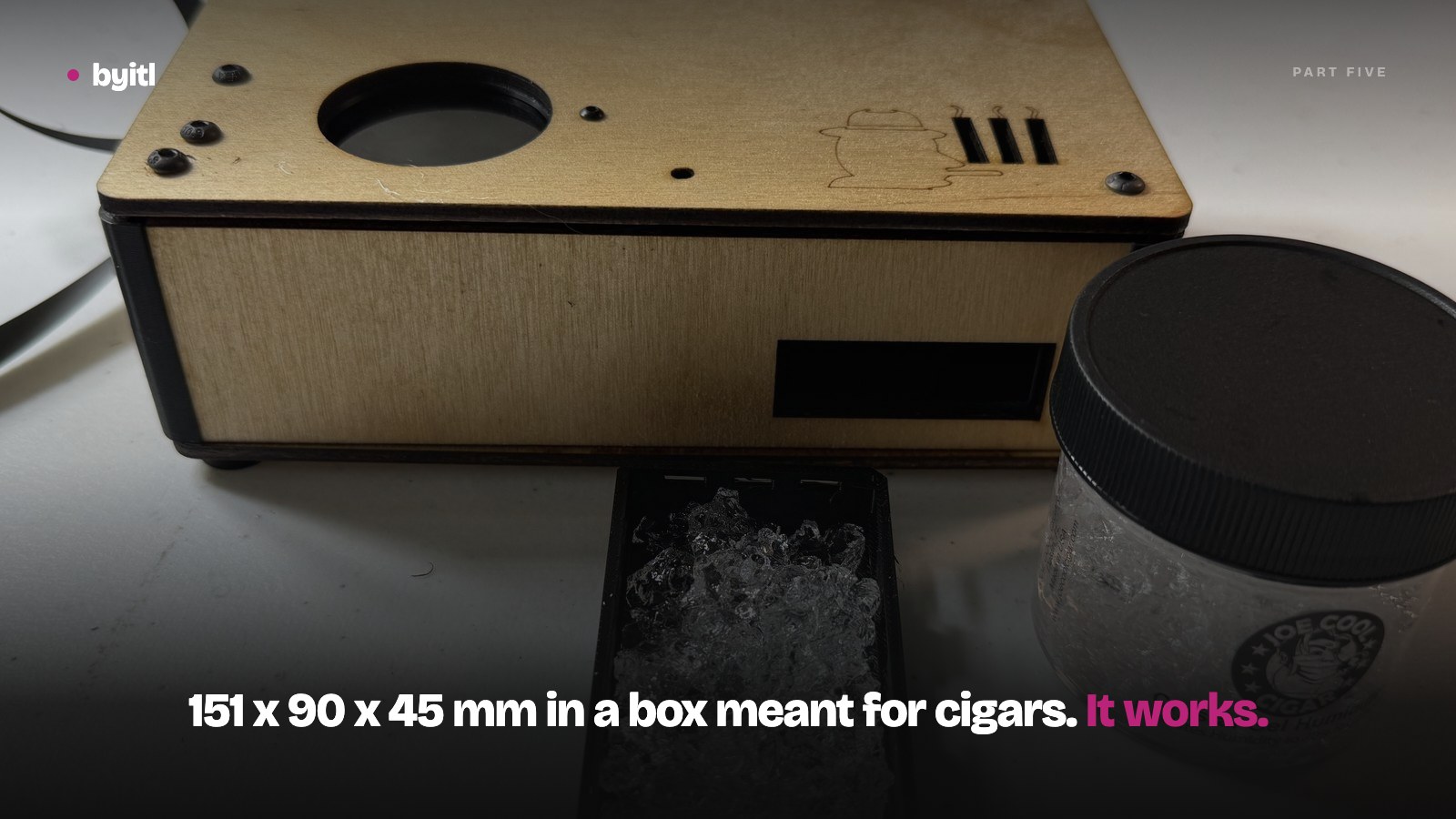
HC-01 works. It's also 151 × 90 × 45 mm, about 0.6 litres, and roughly double what it should be. It's big because of what went inside: a drawer of humidity beads, a fan, a display and a walled-off chamber for the sensor. Each was a reasonable prototype choice. A size target written down at the start forces those choices early instead of after the case is cut. (That post is here.)
Two more things to know before you set a size:
- Under about 40 mm, things get harder. A smaller battery and a tighter board take more design time.
- A first prototype of a very small device is usually somewhat larger than the final product. It works, but it won't have the final look.
Is it going to look like the finished product?
No, and it helps to decide early whether that matters to you. Our prototypes are functional. The case is 3D printed or laser cut in one colour, with no plating, colour matching or packaging. If your first goal is a model that looks finished for photos, tell us. That's a different job from proving the device works.
What makes a project a bad fit before we even talk?
Some answers mean we're the wrong shop, and you should know that before you spend a call on it:
- It plugs straight into a wall outlet with mains voltage inside the device. That's a safety-certification job. We design low-voltage devices that run from an external adapter.
- The prototype must be injection-molded or metal. Mold tooling is a separate production job.
- You need a production run or FCC certification now. Those come after a working prototype, and a test lab does certification.
- Your budget is under $7,500. A custom board, firmware and case with a working unit is real engineering. Below that, a development kit in an off-the-shelf case will serve you better, and I'll say so on the call.
What happens after I send it?
Here's what we do with it:
- A 15-minute call about what the device has to do. You talk to me, not a sales team.
- A written quote: scope, price and timeline. Our full prototype starts at $7,500 and takes 4 to 6 weeks. A simple sensor device sits near the starting price; more boards, more parts or harder assembly cost more. (What sets the price.)
- Design approval. You approve the board layout and case renders before anything is ordered.
- Payment in three parts: 40% at kickoff, 30% at design approval, 30% at handoff. You can stop after any milestone with nothing further owed.
Questions people ask
Should I ask for an NDA before I share my idea? You can ask for one before you share anything. We'll sign yours, or send our short mutual NDA. This isn't legal advice; a patent question belongs with a patent attorney.
I don't know what parts it needs. Is that a problem? No. Picking parts is the engineer's job. Tell us what it should do and we work out the parts.
How long should my description be? One page is plenty. The eight answers, one sentence from the user's side, a size, a budget and a date.
What if I don't know my budget? Say what you could spend without regret. Our floor is $7,500, so if that's out of reach, the call will still tell you a cheaper first step.
Who owns the design? You do, once the work is paid for: board files, firmware and case CAD. You can take them to any manufacturer.
Have an idea and the answers above? Score your device or send a brief, or book a 15-minute call.
Related
It works. It is also too big.
Part five. HC-01 is running in a real humidor: 522 logged samples, agreement with an independent hygrometer, and one closed control loop.
· 6 min read
What it costs to prototype an electronic product
A working prototype of a new electronic device costs thousands, not hundreds. Here is what sets the price, and what byitl charges.
· 4 min read
What a 3D-printed prototype enclosure actually costs in 2026
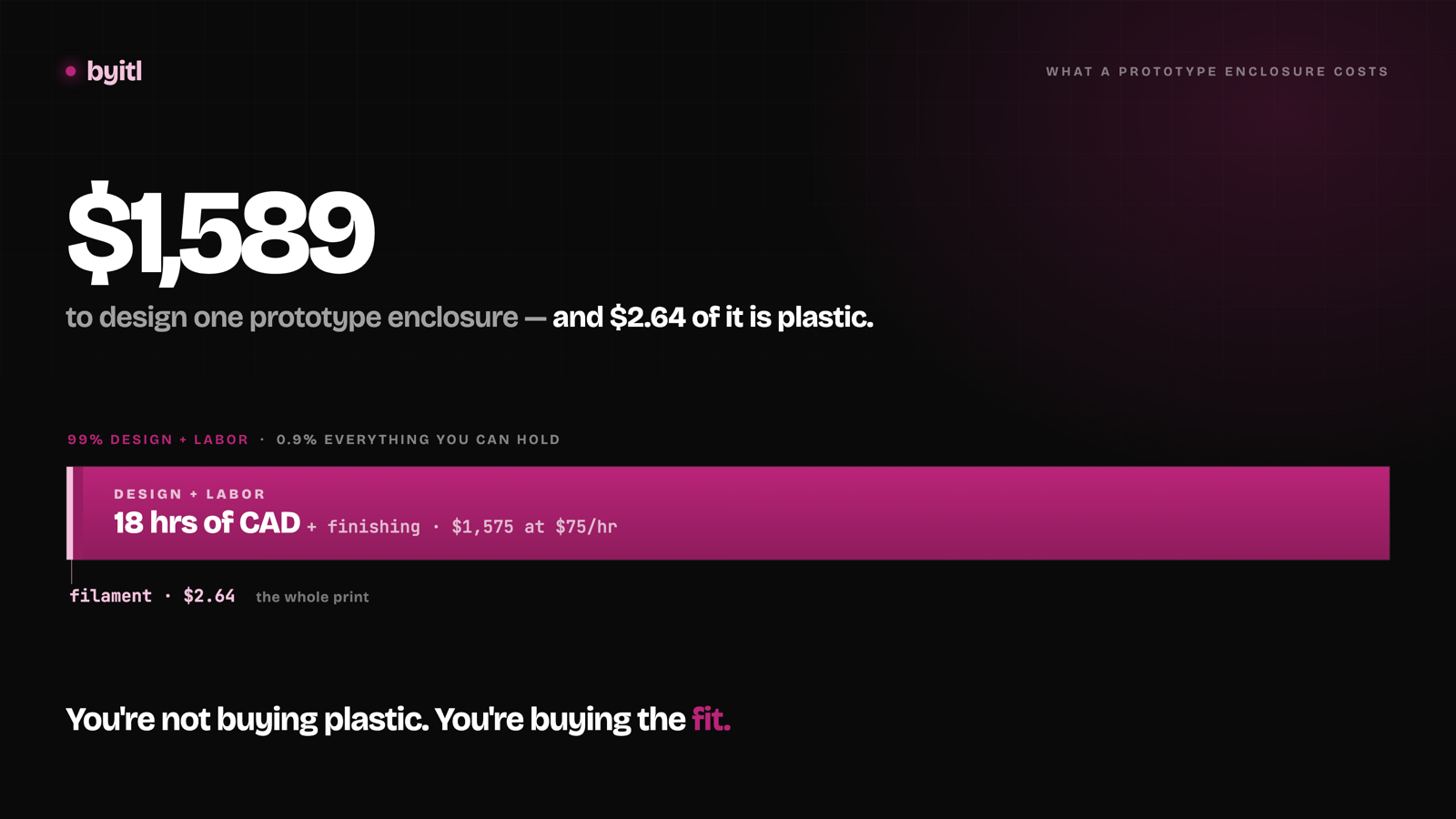
Filament is under half a percent of the bill. Here's the itemized total for a palm-sized ESP32 enclosure, design time included.
· 10 min read