
What it costs to prototype an electronic product
Jerome Privott · · 4 min read
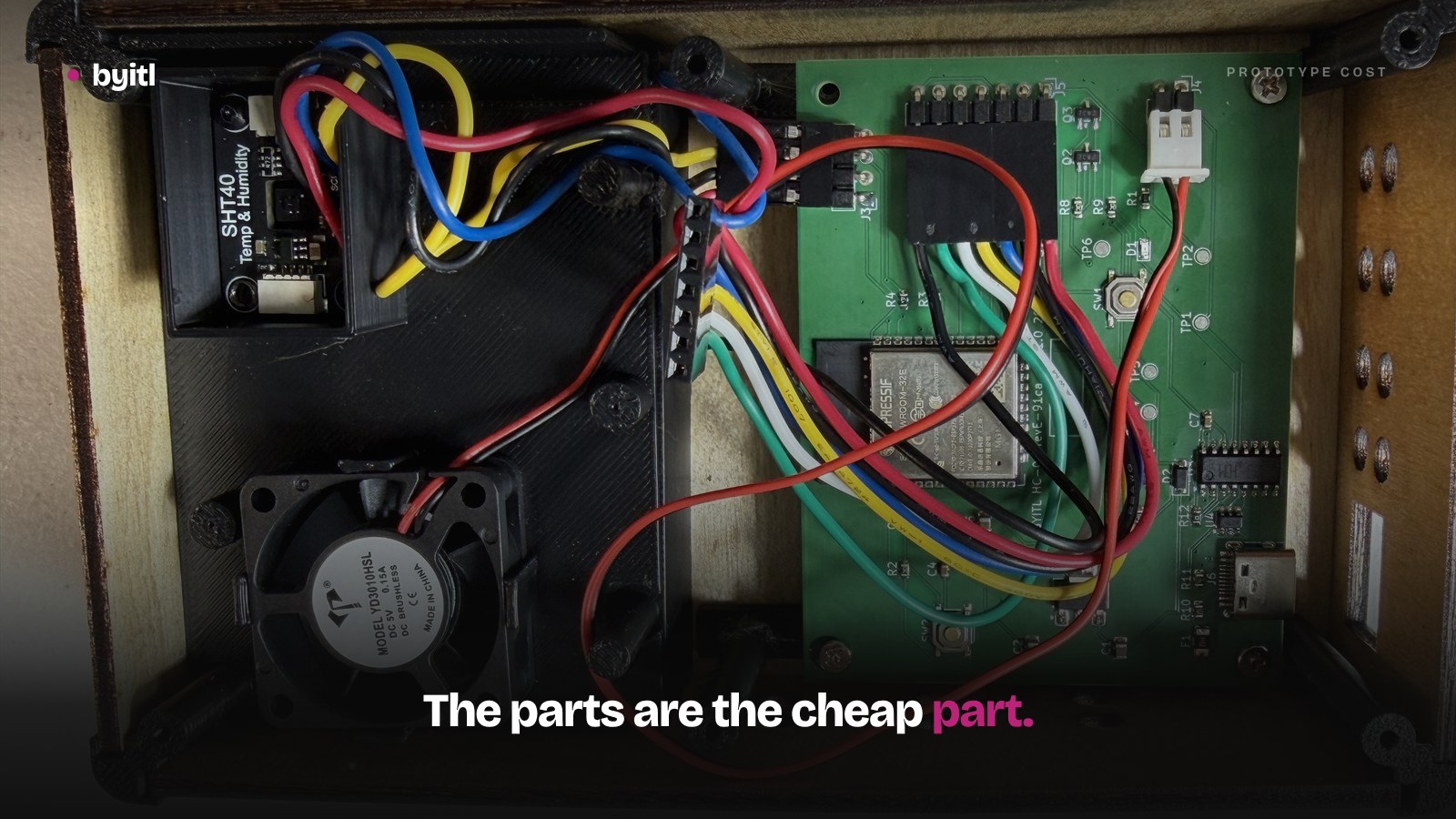
The short answer
A working prototype of a new electronic device costs thousands of dollars, not hundreds. Cad Crowd's 2026 pricing guide puts a prototype with a custom circuit board at $5,000 to $50,000 or more. Ours start at $7,500. That buys the whole device: the circuit board, the firmware that runs it, the case, and one assembled unit that works.
The rest of this post is what goes into that number, what pushes it up, and how to keep yours down.
What you're paying for
A device like a smart keychain or a sensor that texts you has three parts. Each one is its own kind of engineering.
- The circuit board. The green board with the chips on it. Someone designs it, a fab builds it, and someone checks that it actually powers on.
- The firmware. The code on the chip. It's why pressing a button does something.
- The enclosure. The case. It has to fit the board, let the buttons and lights through, and close.
Then all three have to work together in one unit. Getting a new board running for the first time is called bring-up. It's a step in our plan for a reason, and we'll get to that.
The parts are the cheap part
People expect the price to follow the materials. It doesn't. When we itemized a 3D-printed enclosure, the plastic, electricity, printer wear and screws came to $14. Design, finishing and fit testing came to $1,575. (The full breakdown is here.)
Most of a prototype's price is engineering time, and most of that time is spent once. That's also why the tenth unit costs far less than the first.
What pushes the price up
Our quote depends on four things:
- How many boards. One board is simpler than two that have to talk to each other.
- How many parts. Every button, light, sensor and speaker adds design, firmware and assembly.
- How many enclosure pieces. A two-part snap case is quicker than a hinged lid with a battery door.
- How hard it is to assemble. Tiny parts and tight fits take longer to build and test.
What can go wrong, and why it's in the plan
Our own humidor controller, the HC-01, is the honest example. Five assembled boards arrived from the fab. Three never powered on, and two had a display connector only partly soldered. The next revision came back five for five. (That story has its own post.)
The point here is simpler. First boards can come back wrong. A prototype budget and schedule should expect that, not hope it away.
How we price it
- From $7,500. The final price is set after a short scoping call, and you get it in writing.
- The hardware for your working unit is included.
- You pay in three parts: 40% at kickoff, 30% when you approve the design, 30% at handoff.
- You can stop after any milestone and owe nothing more. Paid milestones aren't refunded, because the design time and hardware behind them are already spent.
- Once it's paid, you own the board files, the firmware and the CAD.
- 4 to 6 weeks from kickoff to a working unit.
How to spend less
- Cut version one down to the idea. Build the one feature that proves it. Extra buttons and modes can wait for version two.
- Skip the looks for now. Our prototypes are functional, not retail-finished: no plating, color matching or packaging. That's on purpose. A finish paid for before the device works often gets paid for twice.
- If your budget is under $7,500, a development kit and an off-the-shelf case may be the better first step. I'll tell you that on the call if it's true for you.
What a prototype price doesn't cover
- Retail finish and packaging.
- Injection-mold tooling and volume manufacturing. Those are separate engagements. (When molding starts to pay off.)
- FCC certification. A test lab does that.
Have an idea for a device? Send a brief or book a 15-minute call. You'll talk to me, not a sales team.
Related
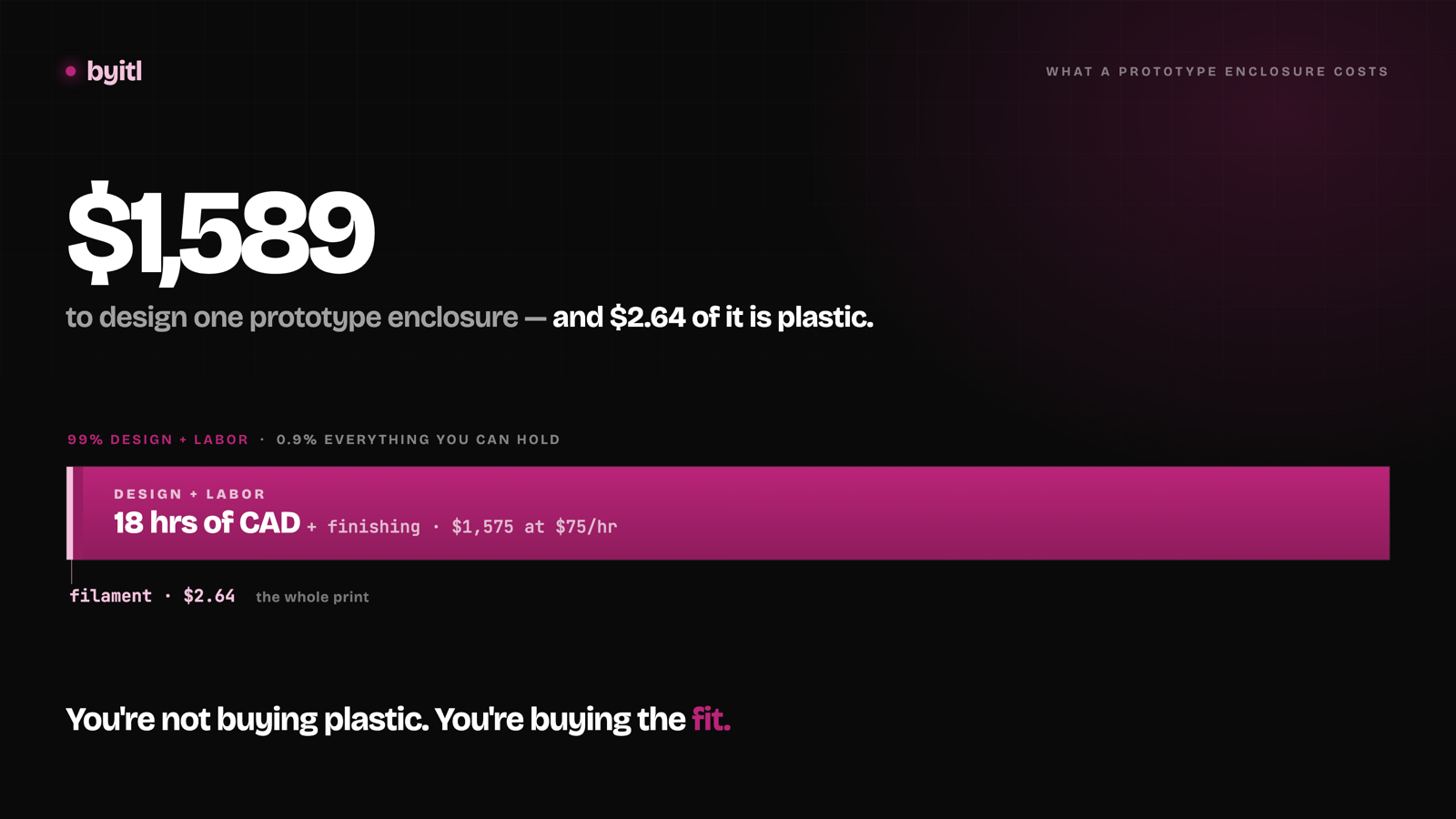
What a 3D-printed prototype enclosure actually costs in 2026
Filament is under half a percent of the bill. Here's the itemized total for a palm-sized ESP32 enclosure, design time included.
· 10 min read
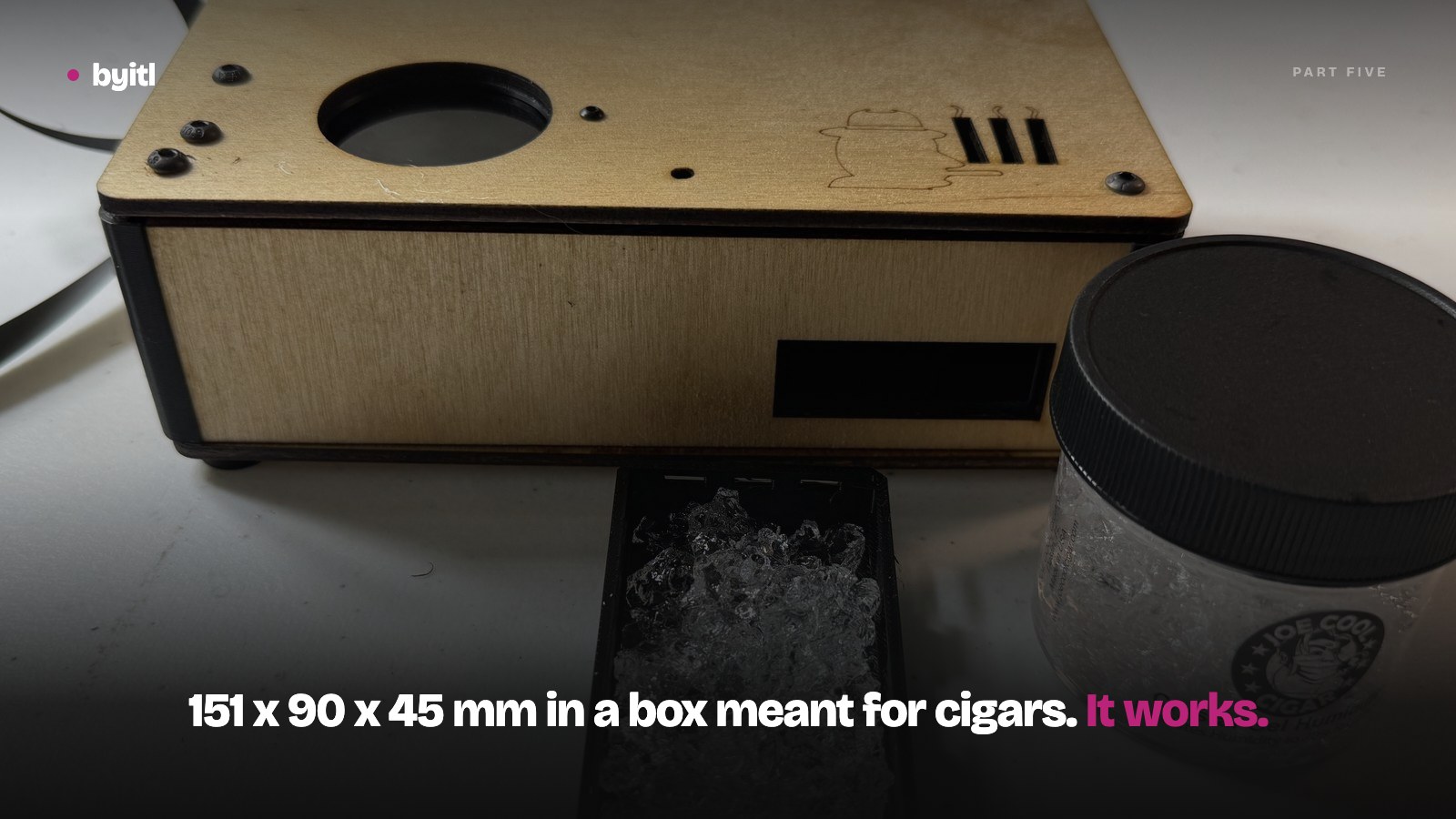
It works. It is also too big.
Part five. HC-01 is running in a real humidor: 522 logged samples, agreement with an independent hygrometer, and one closed control loop.
· 6 min read
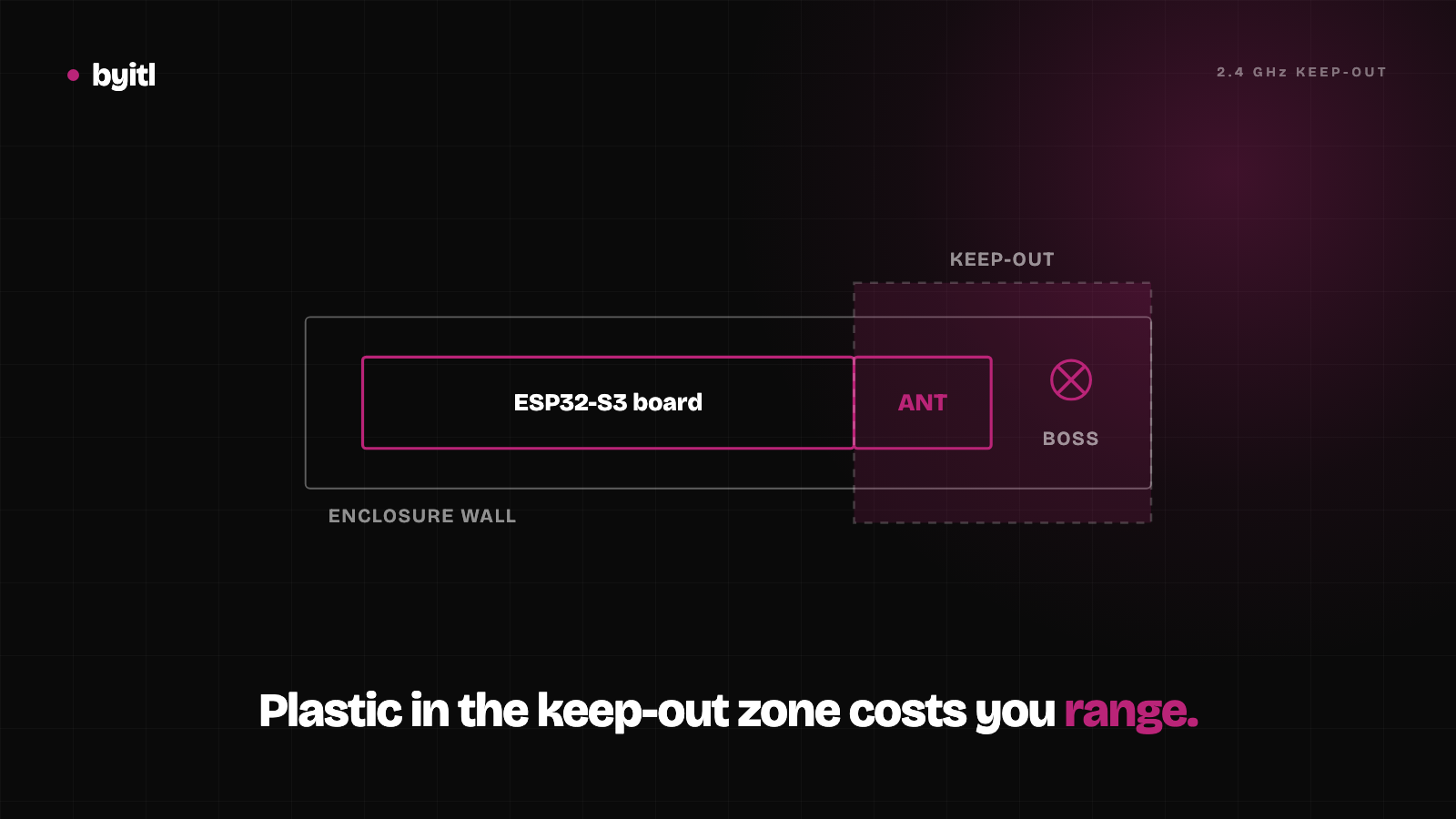
ESP32-S3 enclosure design: give the antenna its 15 mm
Espressif asks for at least 15 mm of clearance around an ESP32-S3's PCB antenna inside the housing. What that means for a 3D-printed case, with sources.
· 6 min read